A dull ache started in one of my back molars on a Sunday night. By Monday I was poking at it with my tongue every five minutes, dreading the bill. Back home, "going to the dentist" meant a number that made me wince before the drill even started. I had no idea what it would cost here in Korea, or whether my insurance would touch it at all.
So I walked into a neighborhood clinic with my Alien Registration Card and braced myself. Here's what I actually paid, and what I wish I'd known beforehand.
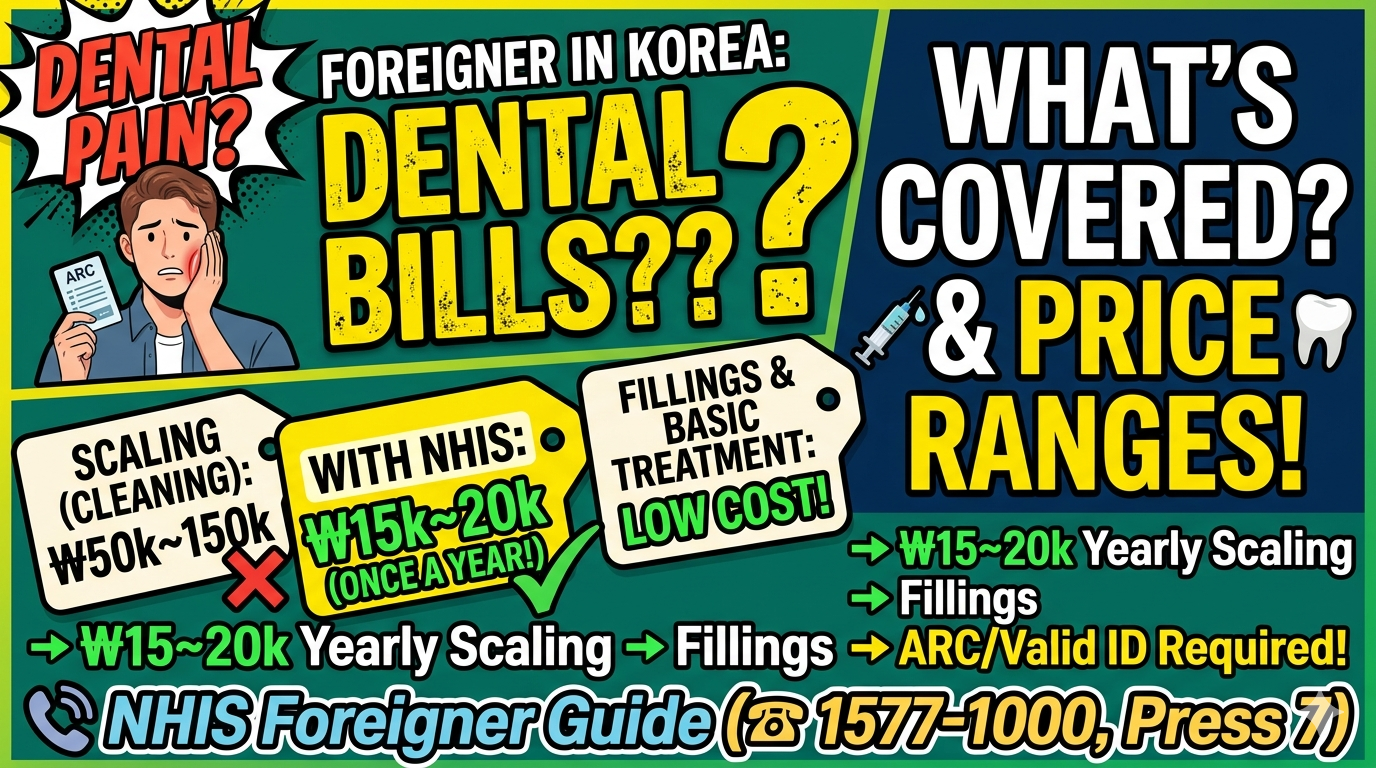
The good news: some of it is covered by NHIS
If you're a registered foreign resident enrolled in the National Health Insurance Service (NHIS), you're not paying full price for everything. For covered procedures, patients typically pay only 30–50% of the total cost out of pocket. You just need to show a valid Korean ID or ARC at the desk.
The one most expats miss
NHIS covers one professional scaling (teeth cleaning) per calendar year, and the count resets every January 1st. With insurance the cleaning often comes out to roughly ₩15,000–20,000, versus ₩50,000–150,000 without. If you haven't used yours this year, it's basically a discount you're leaving on the table.
Rough price ranges (so you're not surprised)
Scaling / cleaning
About ₩15,000–20,000 with NHIS (once a year); ₩50,000–150,000 if paid out of pocket.
Fillings & basic treatment
Often covered in part by NHIS, so you pay a reduced share — usually far less than abroad.
Implants
Mostly self-paid for residents under 65 — commonly around ₩1,000,000+ per tooth (cash prices can start lower). Partial NHIS coverage applies for patients aged 65 and older under set conditions.
💡 Keep in mind — cosmetic work (whitening, veneers) is not covered and is fully self-paid. Prices also vary by clinic and city, so the numbers above are ballpark figures, not quotes.
What I'd tell my past self
1 · Bring your ARC
No valid ID or ARC at the desk means no insurance rate. Don't leave it at home.
2 · Ask "is this covered?" up front
Clinics will tell you which parts are insured (보험) and which are self-paid (비보험) before they start.
3 · Use your yearly scaling
It resets every January. One cheap cleaning a year also catches problems early.
In the end
My molar turned out to need a simple filling, and the bill was a fraction of what I'd feared — because part of it ran through NHIS. The thing that genuinely surprised me was the free-ish yearly cleaning I'd been ignoring for two years.
If you've been putting off the dentist in Korea because you assumed it'd be expensive or complicated as a foreigner, it's usually neither. Bring your card, ask what's covered, and don't waste your annual scaling.
※ Note — This article shares general information based on personal experience and publicly available sources. Coverage details, eligibility, and prices vary by clinic, city, insurance status, and change over time. For your specific situation, confirm directly with the NHIS (☎ 1577-1000) and your dental clinic. (Sources: NHIS dental benefit guidelines; published Korea dental price references, 2026)
Worried about dental bills in Korea as a foreigner? Here's what NHIS actually covers — your free yearly scaling, real price ranges for cleanings, fillings, and implants, and what to bring so you get the insurance rate.
'건강' 카테고리의 다른 글
| Do You Really Need Private Health Insurance in Korea If You Already Have NHIS? (0) | 2026.06.24 |
|---|---|
| I Ignored My Korean Health Insurance Bills — Then It Almost Cost Me My Visa (0) | 2026.06.18 |

