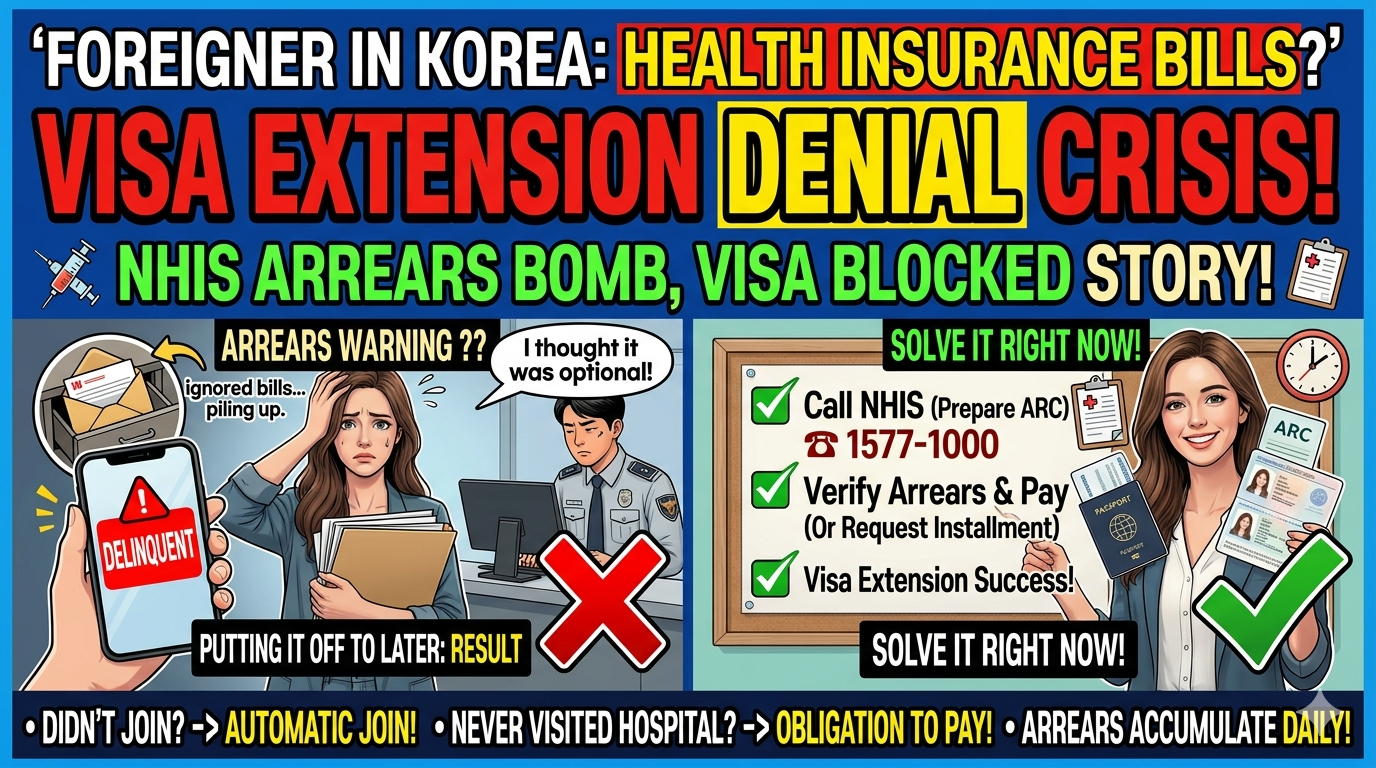
The first envelope went straight into a drawer. It was in Korean, it had a number I didn't recognize, and I'd never set foot in a hospital since arriving. National Health Insurance? I figured it was something I had to sign up for — and since I hadn't, it didn't apply to me. Three more envelopes followed over the next few months. Same drawer.
Then my visa extension came up. I walked into the immigration office with my folder of documents, relaxed, expecting a ten-minute stamp. The officer typed my ARC number, paused, and turned the monitor slightly toward herself. "You have unpaid national health insurance," she said. "I can't give you the full extension like this."
That was the day I learned the thing nobody had told me: in Korea, health insurance isn't something you opt into — and ignoring the bills can follow you all the way to the visa counter.
It's mandatory — and automatic
Here's what I got completely wrong. As a long-term foreign resident with an ARC, you are generally auto-enrolled in National Health Insurance (NHIS) after about six months in the country — you don't have to apply, and the clock keeps running whether or not you ever see a doctor. The bills I was ignoring weren't an invitation to join. They were invoices for coverage I already had.
The part that surprised me most
You get billed even if you never use it. NHIS isn't pay-per-visit — it's a monthly premium, like a subscription. "I never went to the hospital" is not a defense, and the unpaid months simply pile up with late fees attached.
How unpaid premiums reach your visa
This is the connection most people don't see coming. When you apply to extend your stay or change your status, Korean immigration can check your NHIS payment history directly. If there are unpaid premiums on your record, the extension can be shortened — or, if the arrears are serious, refused.
A few unpaid months
Commonly reported outcome: instead of a full extension, you're given a shortened stay period and effectively told to come back once it's cleared. You don't get refused outright, but you're on a short leash.
Larger arrears (often cited around ₩500,000+)
At a higher balance, a flag appears on your ARC record, and the officer sees it the moment they pull up your file. At that point there's no smoothing it over at the desk — the balance has to be cleared.
⚠ There's no "I'll pay later" at the immigration counter. The check happens in real time against your record, so by the time you're sitting across from the officer, it's already too late to negotiate. You clear it before the appointment, not during it.
Late fees make waiting worse
Unpaid premiums don't sit still. A late fee (연체금, yeon-che-geum) is added daily once you pass the due date, growing the longer it's left. The exact rate is small per day, but across several ignored months it adds a meaningful chunk on top of what you already owed. Every week you "deal with it later," the number goes up.
What actually fixed it for me
1 · Call NHIS — 1577-1000
NHIS has English-language support. I called, gave my ARC number, and got the real total — premiums plus late fees — in one number. Guessing from the envelopes only made me more anxious; the phone call took ten minutes.
2 · Ask about a payment plan if you can't pay it all
If the lump sum is too much, NHIS can discuss installment options. Payment plans for foreign residents in a temporary tight spot are routine — but you have to ask before it spirals, not after.
3 · Clear it, then handle the visa
Once paid (or on an approved plan), get proof of payment and then book the immigration appointment. Sorting the insurance first is far simpler than trying to lift a shortened-stay situation afterward.
💡 Not a bug in the system — a benefit you're paying for. Once you're current, that same NHIS slashes your medical bills: covered visits and procedures often cost you only a fraction out of pocket. The goal isn't to escape it; it's to stop treating it like junk mail.
Quick FAQ
Q. I never registered. Do I still owe?
Most likely yes. Enrollment for long-term ARC holders is automatic after about six months — not something you trigger by signing up. Not registering doesn't mean not enrolled.
Q. I'm leaving Korea soon — can I just ignore it?
Risky. Unpaid balances can affect a visa extension or a future re-entry/status change. If you're truly leaving for good, call 1577-1000 and ask how your enrollment ends so it closes cleanly.
Q. The bill seems high for my income — is that normal?
Premiums are calculated from income and assets, and some visa types (like certain students) get reduced rates. If yours looks off, call NHIS and ask them to review how it was assessed.
If you have an envelope in a drawer right now
Open it. I got my full extension in the end — but only after a stressful scramble to clear a balance that had quietly grown for months while I told myself it didn't apply to me. The fix was one phone call I could have made the day the first envelope arrived.
If you're new here, treat NHIS like rent, not like spam. And if you're already a few months behind, call 1577-1000 today — long before any immigration appointment is on the calendar.
※ This article shares a personal experience and general information for foreign residents in Korea; it is not legal, immigration, or financial advice. Enrollment rules, premium amounts, late-fee rates, and visa-extension outcomes depend on your visa type, income, and individual circumstances, and policies can change. For your exact balance and options, contact NHIS at 1577-1000, and for visa matters consult the Korea Immigration Contact Center (call 1345) or a licensed administrative/immigration professional.
As a foreigner in Korea, I assumed those NHIS bills were optional — until my visa extension got flagged. Here's how mandatory health insurance, unpaid premiums, and your visa are connected, and exactly how to fix arrears before they reach the immigration counter.

