I was standing at the Incheon Airport check-in counter with two suitcases and a one-way ticket to my home country when my coworker texted me: "Did you get your pension money back yet?"
I had no idea what she was talking about. For three years I'd watched a line called 국민연금 (National Pension) disappear from my paycheck every month, roughly 4.5% of my salary, and I'd assumed it was just another tax I'd never see again. I'd actually Googled it once during my first year, read that "the E-2 visa is not on the eligible list," and closed the tab. I figured that was that.
It turns out I was about to walk away from just over ₩7,000,000 — money that was legally mine. Here's the trap I almost fell into, and the exact steps that got my refund deposited into my home bank account six weeks later.
THE 30-SECOND VERSION
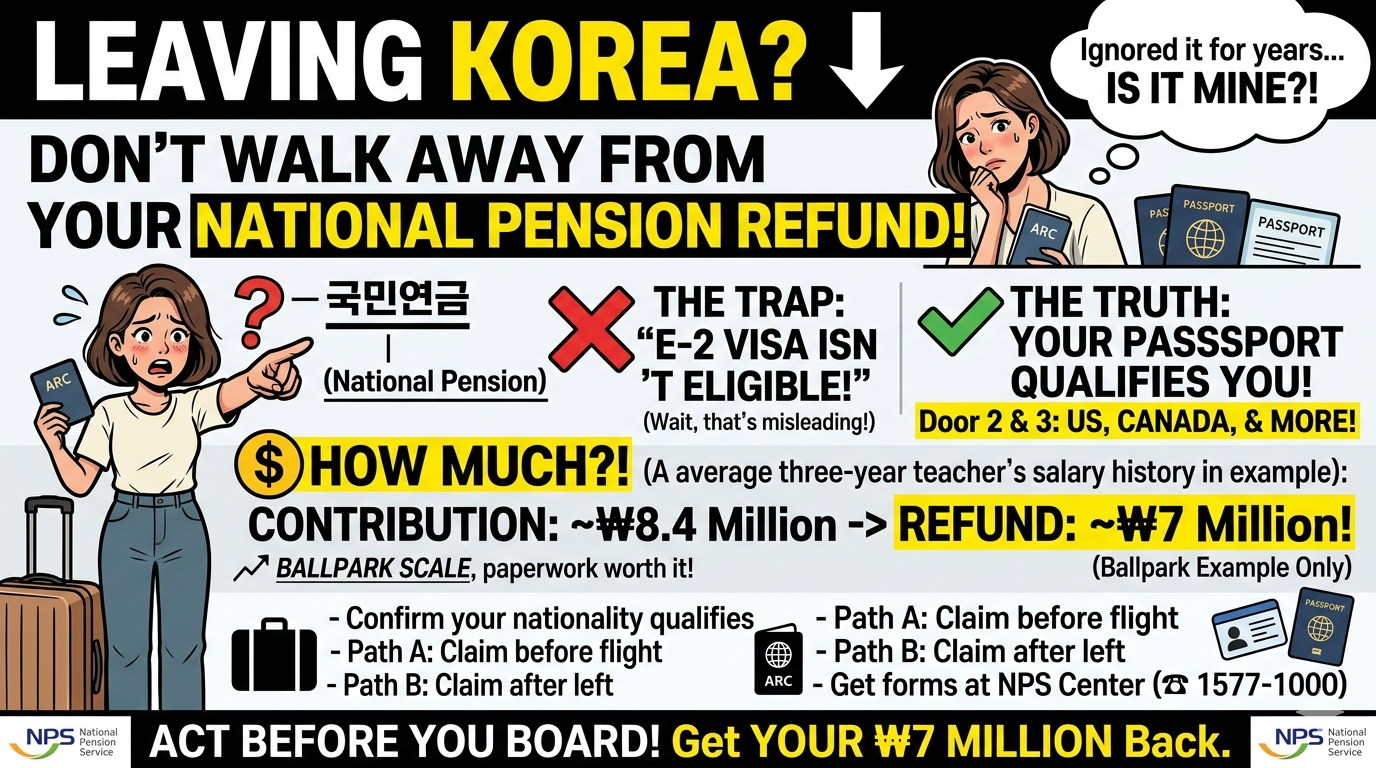
If you're a US, Canadian, or other social-security-agreement national leaving Korea, you can almost certainly claim a lump-sum refund of everything you paid into the National Pension — even on an E-2 (teaching) visa that isn't on the "eligible visa" list. The eligibility comes from your nationality, not your visa. Don't board your flight without sorting it out.
The trap: "E-2 isn't on the eligible list" is technically true — and completely misleading
Here's why I gave up the first time. When you search this, you'll find the official rule that a lump-sum refund is paid to foreigners whose visa falls under E-8 (training employment), E-9 (non-professional employment), or H-2 (visiting employment). E-2 — the visa most English teachers hold — is nowhere on that list. So you reasonably conclude: not me.
But the visa list is only one of three separate doors to eligibility. The other two are about your country:
Door 1 — Your visa is E-8, E-9, or H-2.
Door 2 — Your country has a social security agreement with Korea (the US and Canada both do).
Door 3 — Your country grants Koreans an equivalent lump-sum refund (reciprocity).
You only need to walk through one of these doors. As a US citizen, I qualified through Door 2: under the US–Korea Social Security Agreement, American nationals get equal treatment with Korean nationals for lump-sum refunds — and crucially, regardless of which visa I was on. My E-2 status was irrelevant. My passport did the work.
⚠️ Check your own country first. Not every nationality qualifies. Citizens of countries with no agreement and no reciprocity (and not on an E-8/E-9/H-2 visa) generally cannot get a lump-sum refund. The US, Canada, and many others do qualify — but confirm yours with the National Pension Service before you count the money.
How much is actually sitting there?
The pension contribution is 9% of your monthly salary, split evenly: you pay 4.5% and your employer pays 4.5%. The lump-sum refund returns the contributions paid plus a fixed amount of interest.
A rough sense of scale, for a teacher earning about ₩2.6 million/month for three years:
Do not treat these numbers as a quote. The point is simply this: it is almost never a trivial amount, and it is very much worth one afternoon of paperwork.
The timing rule that almost cost me everything
Here's the part my coworker's text saved me from. You generally cannot claim the refund "whenever." A foreigner claiming on the grounds of leaving Korea is paid only once departure is confirmed. There are two practical paths:
Path A — Claim before you fly
If you can show you're leaving within one month — typically a booked flight ticket — you can file the claim before departure. Your employer should report your resignation to the NPS by the day before you fly.
Path B — Claim after you've left
You can also file from your home country after departure. This is the fallback if you've already left — but it's slower and harder to chase paperwork from abroad. Don't rely on it if you can avoid it.
I was 40 minutes from boarding with no claim filed. I took Path B by necessity, and it worked — but it meant tracking down my final pay records and resignation report from 9,000 km away. If I'd known a week earlier, Path A would have been infinitely easier.
The documents you need (gather these before you pack)
- A copy of your passport
- A copy of your Alien Registration Card (ARC)
- A copy of your flight ticket or reservation (for Path A)
- A copy of the bankbook / account details where the refund will be deposited
- The official lump-sum refund application form
One detail that tripped me up: have your overseas bank account information ready and accurate (SWIFT code, account number, account holder name exactly as it appears on the account). The refund can be sent to a foreign account, and a single typo here is what delays people for months.
Who to contact
Go straight to the source. The National Pension Service – Center for International Affairs handles foreigner refunds in English:
📞 Tel: +82-2-2176-8721
✉️ Email: npsic@nps.or.kr
🌐 Web: www.nps.or.kr (English site available)
Call or email them while you still have your ARC and a Korean phone number. Confirm three things: (1) that your nationality qualifies, (2) whether to take Path A or B, and (3) the exact current document list, since forms change.
One more thing for US & Canadian readers: because of the social security agreement, you sometimes have a choice between taking the lump-sum refund now and "totalizing" your Korean contributions toward your home-country pension later. For most people leaving Korea for good, the lump-sum is the obvious pick — but if you've worked here a long time, it's worth asking which option leaves you better off.
If you're leaving Korea, don't stop at the pension
The pension refund is the one with real money attached, but it's part of a bigger checklist that catches departing expats off guard. Your National Health Insurance (NHIS) status, in particular, can quietly become a problem — I wrote about how unpaid NHIS bills almost cost me a visa in "I Ignored My Korean Health Insurance Bills — Then It Almost Cost Me My Visa." Settle both before you fly.
I got my ₩7 million. It took six weeks, a few stressful emails from a different time zone, and one very well-timed text from a coworker. You don't need the lucky text — you just need to file before you board.
Disclaimer: This article shares one person's experience and general public information for reference only; it is not legal, tax, or financial advice. Eligibility, amounts, processing times, and required documents depend on your nationality, visa, contribution history, and individual circumstances, and rules can change. Always confirm your specific situation with the National Pension Service (nps.or.kr) before acting.
Sources: National Pension Service — Foreigners & Lump-sum Refund (nps.or.kr); NPS Social Security Agreement / Lump-sum Refund pages (nps.or.kr); U.S.–Korea Social Security Agreement (ssa.gov). Verified June 2026.
Leaving Korea? You may be owed millions of won in pension contributions back — and the E-2 "visa not eligible" rule is a trap. Here's exactly how I claimed mine.


