I Got Food Poisoning During Korea's Rainy Season — Here's Exactly How I Saw a Doctor (as a Foreigner)
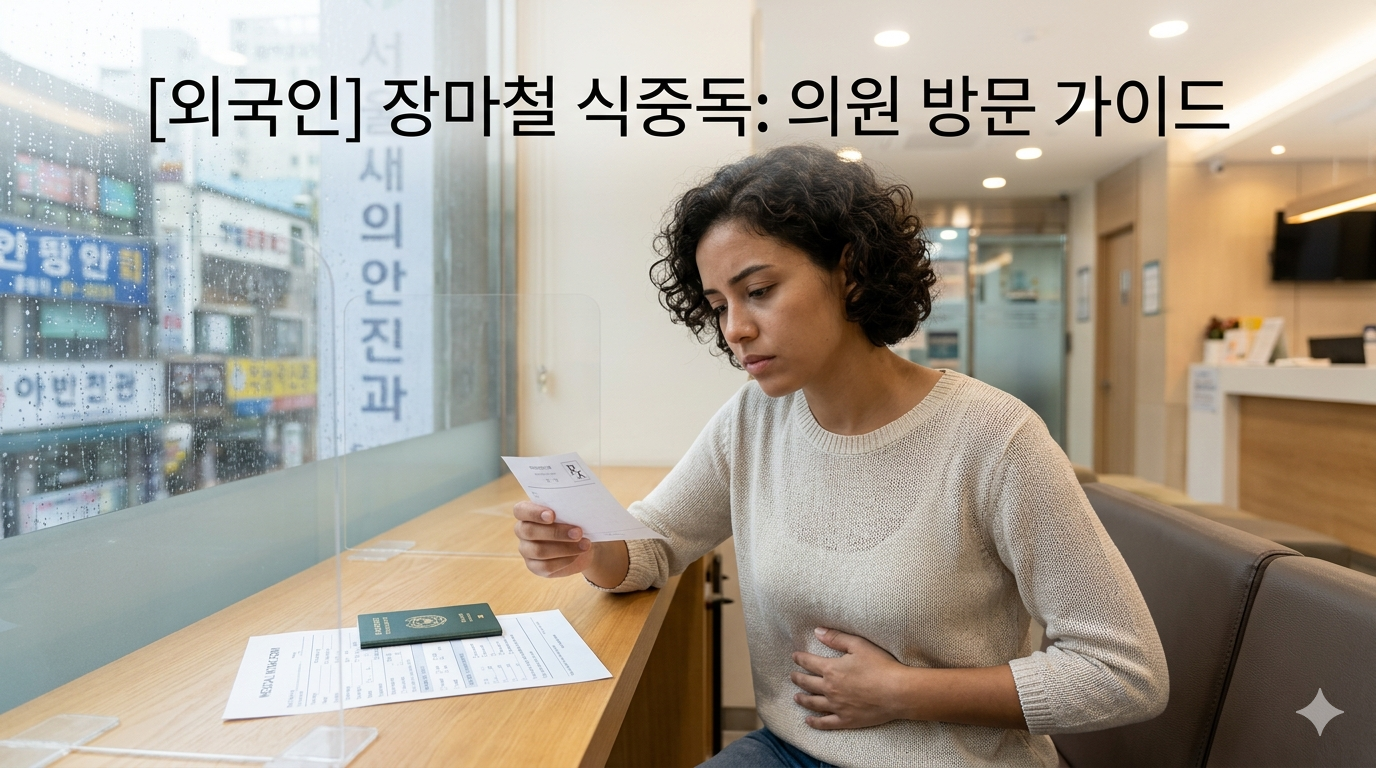
It was the second week of jangma — Korea's rainy season — and the air in my Seoul apartment felt like warm soup. I'd eaten some gimbap that had sat out a little too long the day before. At 6 a.m. I woke up with my stomach twisting, sweating, and making frantic trips to the bathroom. I was alone, I didn't speak much Korean, and I had no idea where to even start.
If you live in or are visiting Korea in summer, this is one of the most common ways you'll end up needing a doctor. The heat and humidity of the rainy season are perfect conditions for food going bad fast. So here's exactly what I did, what it cost, and what I wish I'd known before that miserable morning.
1. The first thing to know: you can just walk in with your passport
I assumed I needed an appointment, an insurance card, a Korean phone number — something complicated. I didn't. In Korea, you can see a doctor as a foreigner with just your passport (or your Alien Registration Card if you have one). Neighborhood clinics run on walk-ins — no appointment needed. I walked in, handed over my passport, filled out a short form, and waited about 15 minutes.
Key point: For something like food poisoning, don't overthink it. Find a local clinic, bring your passport, and walk in. That's genuinely the whole process.
2. The mistake people make: going to a big hospital for a small problem
My instinct was to go to a large university hospital because it sounded "safer." That would have been a mistake — and an expensive one.
Korea has a tiered medical system. For minor issues like an upset stomach, you want a Tier 1 neighborhood clinic (의원, uiwon) — usually a small practice often labeled something like "Internal Medicine (내과)." Going straight to a large "tertiary" hospital for a minor complaint means longer waits and higher fees, because the system is designed to push routine care to local clinics first.
- Stomach ache, cold, minor injury → local clinic (의원). Short wait, lowest cost.
- Serious or emergency → larger hospital or ER.
Wait times at neighborhood clinics are typically 10–30 minutes. I was seen quickly, the doctor pressed on my stomach, asked what I'd eaten, and prescribed medication.
3. What it actually cost
This is the part that surprises most foreigners. Even at the uninsured (non-NHIS) foreigner rate, a clinic visit for something like this in Korea is often cheaper than an insured visit would be in the US. That low cost is a big reason Korea draws hundreds of thousands of medical-tourism visitors a year.
For my food poisoning visit, the clinic consultation plus the prescription at the pharmacy came out to a very manageable amount — the kind of bill that doesn't make you panic. Exact prices vary by clinic and whether you're covered by National Health Insurance, so it's worth calling ahead if you want a precise figure.
Key point: If you're enrolled in Korea's National Health Insurance (NHIS), your share is even smaller. But even without it, don't avoid the clinic out of fear of the cost — for routine care, it's low.
4. The pharmacy is a separate stop — and that's normal
One thing that confused me: the clinic doesn't give you the medicine. In Korea, the doctor gives you a prescription, and you take it to a separate pharmacy (약국, yakguk) — usually right next door or within sight of the clinic. The pharmacist fills it on the spot. For my food poisoning I got medication for the nausea, the cramps, and rehydration. Within a day I felt human again.
5. If it happens to you, do this
- Don't panic about the language. Many clinics in expat-heavy areas have English-speaking staff; if not, translation apps work fine for "stomach, vomiting, since this morning."
- Go to a local clinic (의원), not a big hospital, for minor illness — faster and cheaper.
- Bring your passport (or ARC). That's all you need to be seen.
- Fill the prescription at the pharmacy next door. The clinic won't hand you the medicine directly.
- Stay hydrated and rest. Summer food poisoning plus humidity dehydrates you fast.
The rainy season is when food spoils quickest, so be extra careful with leftovers and anything that's been sitting out. But if you do get caught out like I did — now you know the system isn't scary. One short clinic visit, one pharmacy stop, and you're on the mend.
This is a personal account combined with general public information. Costs, English-language availability, and coverage depend on the specific clinic, your insurance status, and your situation. For emergencies in Korea, call 119. For non-emergency medical help and interpretation, the 1339 health information line and the 1345 immigration/foreigner line can assist.


