I Skipped Three Months of Korean Health Insurance — and Almost Lost My Visa Extension
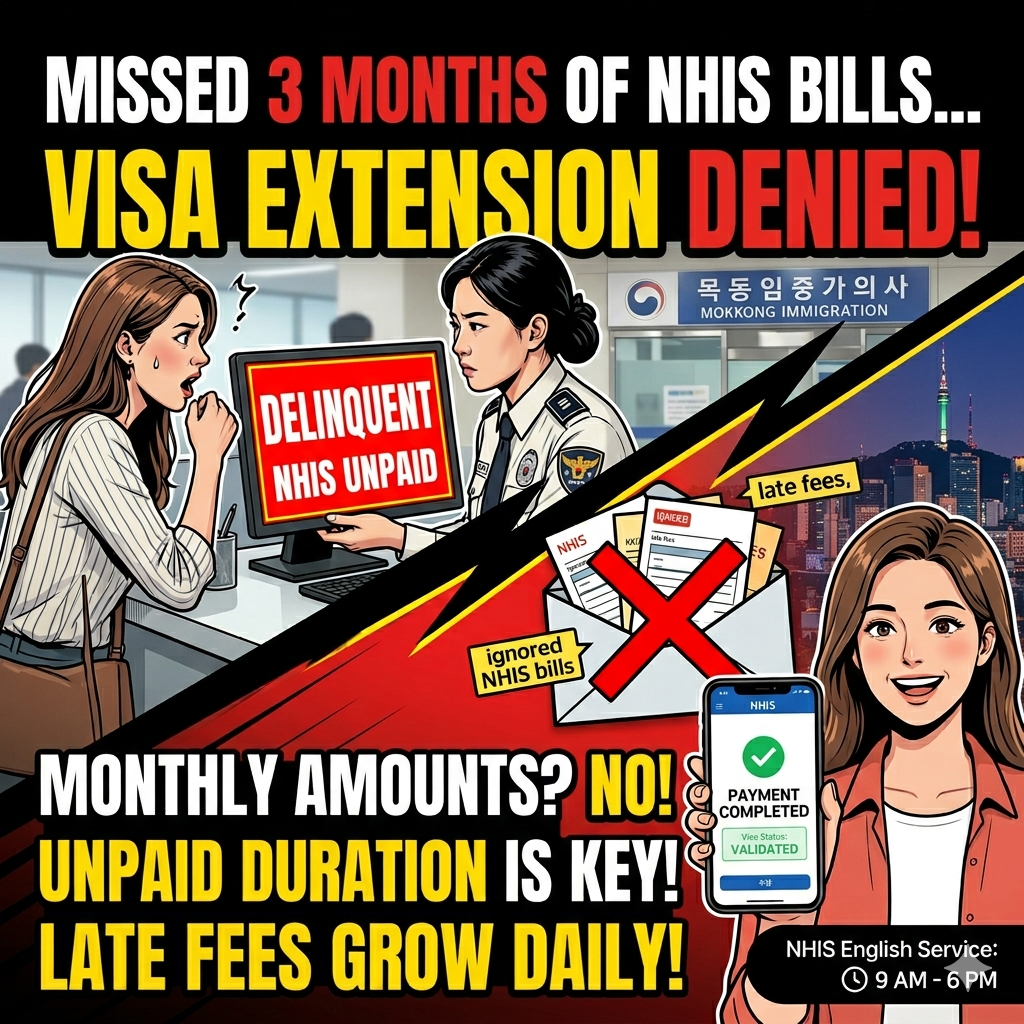
The officer at Mokdong Immigration didn’t even look up at first. She scanned my Residence Card, and then she paused. I watched a small red banner pop up on the corner of her monitor — I couldn’t read the Korean, but I could read her face. She turned the screen slightly toward her colleague, said something quietly, and then looked at me.
“You have unpaid health insurance,” she said. “Three months.”
I had come in to extend my visa for another year. I left that day with a six-month stamp instead — and a very specific number to pay before I’d be allowed back.
If you’ve been letting those NHIS bills pile up because the app is in Korean and the auto-transfer never got set up, this is the part nobody warns you about. It’s not just a late fee. It touches your visa.
The rule isn’t about how much you owe — it’s about how many months
This is the thing I got wrong. I assumed there was some big won-amount line, and that as long as I stayed under it I was fine. That’s not how the immigration check works.
Since August 2019, the Ministry of Justice runs an arrears-check program together with NHIS and the Ministry of Health and Welfare. When you go to extend your stay, the immigration officer sees your unpaid-premium status on screen. And it is count-based:
- 1 to 3 months unpaid: the officer can cap your extension at six months or less. That’s what happened to me.
- 4 months unpaid or more: the extension can be denied.
There’s a separate amount-based flag too: if you owe more than 500,000 KRW, the Ministry of Justice gets a direct mark on your Residence Card profile. That’s the red banner I saw. So you can get caught two different ways — by the number of months, or by the total amount. I managed to do both.
What the late fees actually cost
While I was avoiding the bills, they were quietly growing. The late fee on NHIS arrears is a daily charge, not a flat penalty:
- 0.1% per day for the first 30 days past the due date, capped at 3% of the arrears.
- Then an additional 0.033% per day after that, with the combined cap at 9% of the arrears.
So it’s not ruinous interest, but it never stops climbing until you pay. My three months had become noticeably more than three months’ worth of premiums.
What I actually did to fix it
Here’s the part I wish I’d known on day one, because it was far less painful than I’d built it up to be in my head.
1. I called NHIS at 1577-1000 and pressed 7 for English. Hours are weekdays 09:00–18:00. I expected a fight. Instead the agent pulled up my account, told me the exact total including late fees, and — this surprised me — offered a payment plan. NHIS routinely approves small installment plans for foreign residents who are temporarily short on cash. If I’d called before the due date passed, I could have avoided the visa flag entirely.
2. I paid the arrears, then got proof. Once the balance was cleared, the flag on the immigration system comes off. Clearing the debt up front is far simpler than trying to lift a six-month stay-cap after the fact — once that shorter stamp is in your passport, you’re living with it until the next extension.
3. I set up automatic bank transfer (자동이체) so it never happens again. This is the real fix. The single most common reason expats fall into arrears isn’t money — it’s that the bill is on paper or in a Korean-only app and quietly gets ignored.
If you’re reading this before your extension
Don’t walk into immigration with unpaid premiums and hope it slides through. It won’t — the officer sees it before you say a word. Call 1577-1000 (press 7), settle or set up a plan, and only then book your extension appointment. A 20-minute phone call is the difference between a clean one-year stamp and the six-month stamp I had to live with.
And if you’re leaving Korea instead of extending: don’t just disappear owing money. If you paid a full month but depart mid-month, you may be entitled to a pro-rated refund — but you have to give NHIS a Korean bank account number before you close it. Once you surrender your Residence Card at the airport, your coverage is automatically cancelled the next day.
Disclaimer: This is a personal account for general information only and is not legal or immigration advice. Rules and amounts can change, and individual cases vary by visa type and circumstances. Always confirm your own situation with official sources: NHIS at 1577-1000 (press 7 for English) and the Korea Immigration Service at 1345, or HiKorea (hikorea.go.kr).


