Going to a Hospital in Korea as a Foreigner: What Actually Happens (Step by Step)
What you need to know first: Korean hospitals are fast, affordable, and genuinely world-class. A typical clinic visit costs ₩10,000–₩30,000 after NHI coverage. You don't need an appointment for most things. But the system works differently from what most Westerners are used to — and knowing what to expect makes everything easier.
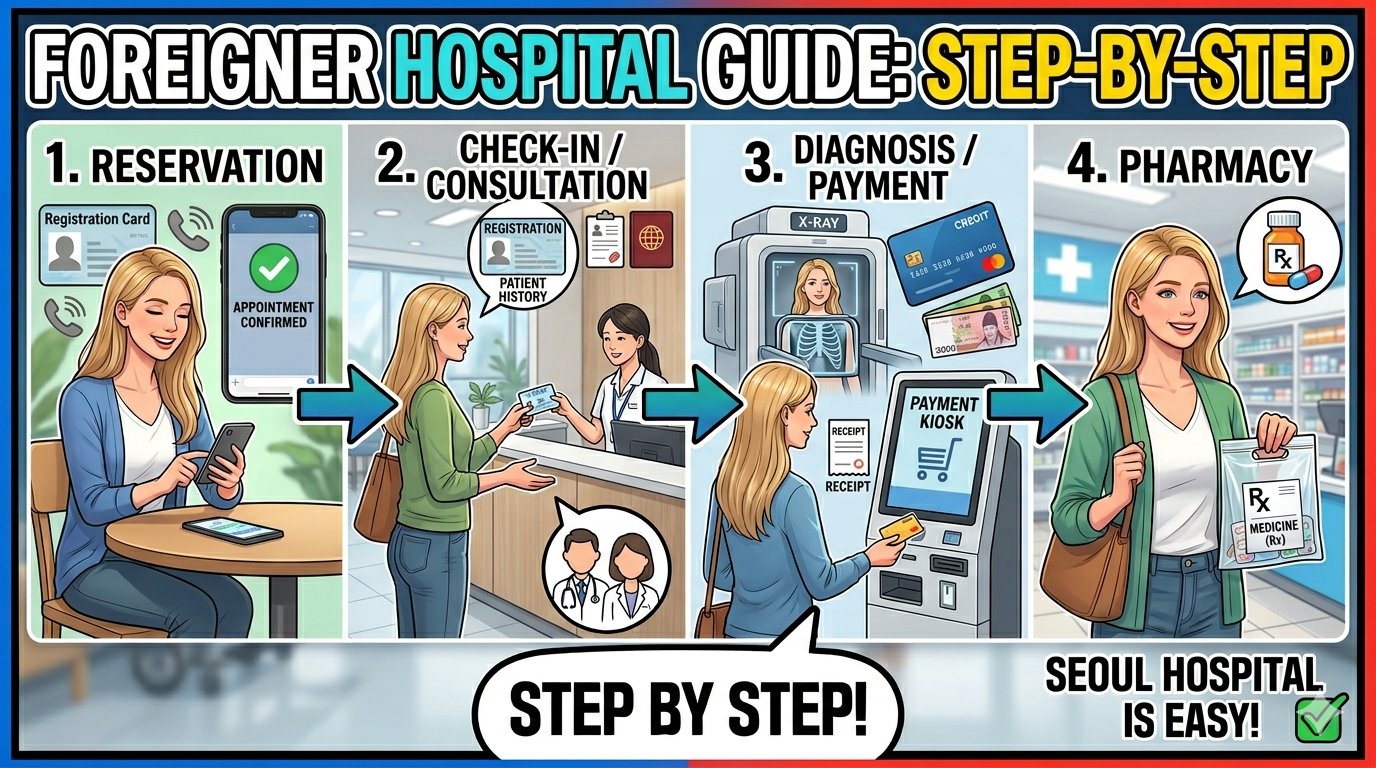
The First Time I Walked Into a Korean Clinic
Three weeks after moving to Seoul, I got a bad cold that turned into a sinus infection.
Back home, I would have waited two weeks for a GP appointment, spent an hour in a waiting room, and paid $40 for a copay. Here, I typed "이비인후과" (ENT clinic) into Naver Map, walked five minutes, took a number, and was seen by a doctor in 22 minutes.
Total cost with my Korean NHI card: ₩12,000. Prescription picked up from the pharmacy next door: ₩4,500.
That was the moment I understood why expats who've lived here call Korea's healthcare system one of the best-kept secrets of expat life.
Step 1 — Find the Right Type of Clinic
Korea's medical system is organized by specialty in a way that's different from most Western countries. There's no real "GP" system the way Americans or British are used to. Instead, you go directly to a specialist clinic.
Here are the most common types you'll use:
| Korean Term | What It Is | When to Go |
|---|---|---|
| 내과 (Naekwa) | Internal medicine | Colds, flu, stomach issues, general illness |
| 이비인후과 (ENT) | Ear, nose, throat | Sinus infections, ear pain, sore throat |
| 정형외과 | Orthopedics | Joint pain, back pain, sports injuries |
| 피부과 | Dermatology | Skin conditions, rashes, acne |
| 산부인과 | OB/GYN | Women's health |
| 응급실 | Emergency room | Serious emergencies |
How to find one: Search "내과 near me" on Naver Map or Kakao Map, or use the English-language hospital finder at e-gen.or.kr.
Step 2 — What to Bring
At minimum:
- Your Alien Registration Card (ARC) — This links to your NHI enrollment. Without it, you'll be charged the full uninsured rate (about 3x more).
- Your phone — For translation apps and payment.
Optional but helpful:
- A note with your symptoms written in Korean (or a translation app ready)
- List of any current medications
- Previous medical records if relevant
Step 3 — Registering at the Front Desk
Walk up to the reception desk and hand over your ARC. They'll ask for your name, date of birth, and reason for visit.
If your Korean is limited, these phrases help:
- "영어 할 수 있어요?" (Does anyone speak English?)
- Point to where it hurts and say the body part
- Use a translation app — staff are generally patient and used to this
Many clinics in central Seoul and near universities have at least one English-speaking staff member. Outside major cities, less so.
You'll get a number or be told to sit and wait. Wait times at local clinics are typically 10–30 minutes. University hospitals can be longer.
Step 4 — The Doctor Visit
Korean doctor consultations are brief by Western standards — often 3 to 7 minutes. Don't be alarmed. Doctors here see more patients per day and move efficiently.
What to expect:
- The doctor will ask your symptoms (often a nurse takes basic info first)
- Brief physical examination
- Diagnosis and prescription, or referral for tests (blood work, X-ray, MRI)
If you need tests, they're often done the same day in the same building. Blood results can come back within 2 hours. X-rays are immediate.
Important: If you're given a prescription, you don't fill it at the clinic — you take the paper to any nearby pharmacy (약국). Pharmacies are almost always within 50 meters of any clinic.
Step 5 — Understanding Your Bill
After your visit, you pay at reception. The bill will show:
- Total cost
- NHI-covered portion (you don't pay this)
- Your copay (본인부담금)
Typical copays at local clinics: ₩5,000–₩15,000.
At university hospitals: ₩10,000–₩40,000.
Get an itemized receipt — called 진료비 세부내역서. This is essential if you plan to claim on private insurance later. Ask for it at the counter: *"세부내역서 주세요."*
Step 6 — Filing a Private Insurance Claim (If You Have One)
If you have Korean private health insurance (실손보험) through your employer or independently, you can claim your copay back.
What you need:
- Itemized receipt (세부내역서)
- Standard receipt (영수증)
- Prescription receipt from pharmacy (if applicable)
How to submit: Through your insurer's app (most have English interfaces), by email, or in person at a branch.
Typical reimbursement: 70–90% of your copay, depending on your policy generation and the type of treatment.
The Emergency Room: What's Different
If you need an ER (응급실), go directly to the nearest hospital with one. You don't need a referral.
What's different from Western ERs:
- Triage is fast and efficient
- You'll likely be seen within an hour for serious issues
- Costs are higher than clinic visits but still much lower than Western equivalents
- Bring your ARC — without it, you'll pay full uninsured rates upfront and apply for a refund later
For life-threatening emergencies: ☎ 119 (ambulance) or ☎ 1339 (medical emergency hotline, English available)
English-Speaking Clinics in Korea
Major international clinics with English-language services:
- Seoul National University Hospital International Healthcare Center — 02-2072-0505
- Asan Medical Center International Healthcare Center — 02-3010-5001
- Yonsei Severance Hospital — 02-2228-5800
- Samsung Medical Center International Health Services — 02-3410-0200
For a full list by region: koreaemergency.or.kr or search "영어 가능 병원" (English-speaking hospital) on Naver.
What Actually Surprises Most Expats
Cost: A visit to a specialist clinic with prescription often comes to under ₩20,000 total. Many expats from the US, UK, or Australia go through genuine sticker shock — in the good direction.
Speed: Same-day blood tests, X-rays, and even MRI results. No two-week waits.
Quality: Korea consistently ranks among the top healthcare systems globally. Equipment is modern and doctors are well-trained.
The paperwork: It's in Korean. Bring your ARC. The system rewards those who are prepared.
FAQ
Do I need NHI to see a doctor in Korea?
No, but you'll pay significantly more without it. With NHI, you pay roughly 20–30% of the total cost. Without it, you pay 100%.
Can I see a doctor without an ARC?
Yes, but again at full cost. If you're on a tourist visa and get sick, you can still visit clinics — bring your passport.
Do I need to make an appointment?
For most local clinics, no. Walk-in is standard. University hospitals and specialists often require appointments, especially for consultations.
What if I need a specialist referral?
For university hospital specialist visits, you technically need a referral from a smaller clinic for reduced rates. Going directly is possible but costs more.
Is dental covered by NHI?
Basic procedures (fillings, extractions) are partially covered. Implants, cosmetic dentistry, and orthodontics are not. Dental in Korea is still significantly cheaper than most Western countries even without coverage.
Disclaimer: This article reflects general information and personal experience. Healthcare costs and insurance coverage vary by situation, policy type, and facility. For medical emergencies, call 119. For English-language health information, contact the NHIS English helpline at 1577-1000 (press 7).


