My Korean Health Insurance Claim Got Denied — Here's What I Did Next
The short answer: A denial isn't the end. In Korea, you can appeal directly to your insurer, then escalate to the Financial Supervisory Service (FSS) for free. Most denials for "medical necessity" are worth challenging — especially for physical therapy and MRI costs.
The Text Message I Didn't Expect
I'd been living in Seoul for two years. Thought I had the healthcare thing figured out.
Then I went in for physical therapy on my lower back — ten sessions, about ₩380,000 total. Filed a claim with my private health insurance (실손보험). Three days later, a text arrived:
*"Your claim has been reviewed. Due to insufficient medical necessity, we are unable to process payment at this time."*
₩380,000. Gone. Or so I thought.
Here's what I wish someone had told me before I just accepted that denial and moved on.
Why Korean Insurance Claims Get Denied (The Real Reasons)
After going through the appeal process and talking to others in the expat community, I found that most denials fall into five categories.
1. "Medical necessity not recognized" — The most common one. Your insurer hires its own medical advisor who overrules your doctor's judgment. This happens constantly with physical therapy, chiropractic-style treatments (도수치료), and non-covered injections.
2. Missing documents — No itemized receipt (진료비 세부내역서), wrong diagnosis code, or missing prescription. This is actually the easiest to fix: just resubmit with the right paperwork.
3. Non-covered treatments — Cosmetic procedures, certain dental work, laser eye surgery. These are genuinely excluded. Hard to appeal.
4. Expired claim period — Korea's insurance claims have a 3-year statute of limitations from the date of payment. Miss that window and you lose the right entirely.
5. Pre-existing condition disputes — If you had a related condition before your policy started, the insurer may try to exclude it.
Step-by-Step: How to Appeal in Korea
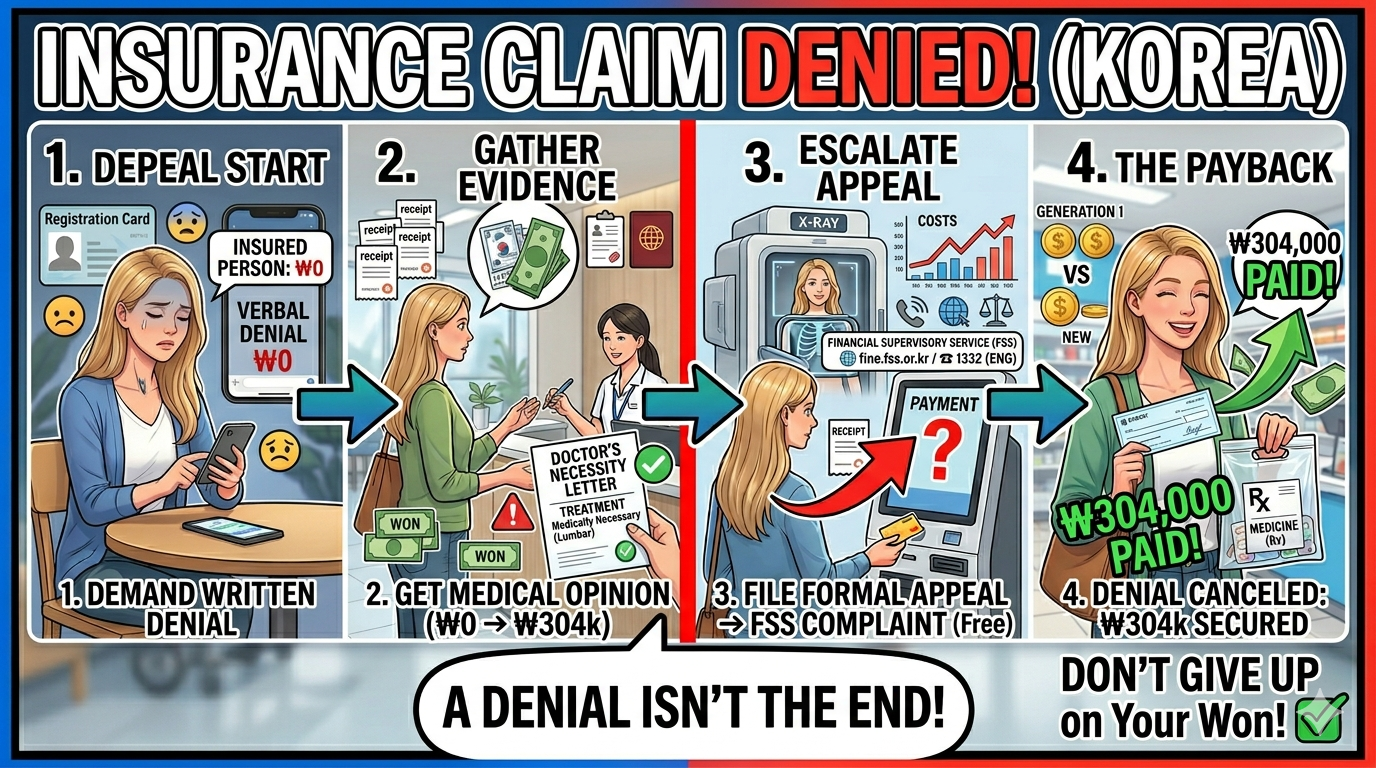
Step 1 — Get the denial in writing
Call your insurer and ask for the official denial letter (지급거절 통보서) with the specific reason stated. Don't just accept a verbal or text explanation.
Step 2 — Get a doctor's statement
Go back to the treating doctor and ask for a medical opinion letter (진료소견서 or 의사소견서). The key phrase to ask them to include:
*"This treatment was medically necessary for the treatment of [condition], not for cosmetic or preventive purposes."*
That one sentence makes a significant difference in the review process.
Step 3 — File a formal appeal with your insurer
Submit your appeal in writing — through the insurer's app, by email, or in person. Include:
- The original denial letter
- All original receipts and itemized billing
- Your doctor's medical opinion letter
- A brief written statement explaining why you believe the denial is incorrect
Insurers are required to respond within 10 business days.
Step 4 — If still denied: FSS Complaint
If the insurer upholds the denial, escalate to the Financial Supervisory Service (금융감독원).
- Website: fine.fss.or.kr (Korean) — English support available by phone
- Phone: ☎ 1332 (press for English assistance)
- Cost: Free
Filing a complaint puts formal pressure on the insurer to review again. Many cases that were initially denied get partially or fully paid out at this stage.
Step 5 — Financial Dispute Mediation
If the complaint doesn't resolve it, you can file for formal dispute mediation (금융분쟁조정). This is still free, takes 30–60 days, and does not require a lawyer.
What Happened With My Claim
I went back to my physical therapist, explained the situation, and asked for a medical opinion letter. She wrote one in under 10 minutes — a simple statement confirming the treatment was for a diagnosed lumbar condition, not elective.
I submitted the appeal through my insurer's app with the letter attached.
Eight days later: ₩304,000 deposited to my account.
Not the full amount — my policy had a self-pay portion — but significantly better than ₩0.
What Expats Often Get Wrong About Korean Private Insurance
Mistake 1: Assuming NHI (국민건강보험) and private insurance are the same thing.
Korea's National Health Insurance (NHI) is mandatory for most foreigners staying 6+ months. It covers a portion of government-approved (급여) treatments. Private health insurance (실손보험) is separate and covers your out-of-pocket costs — but only within the policy's terms.
Mistake 2: Not checking which generation of policy you have.
Korean private health insurance has changed significantly across 4 generations (5th generation launched May 2026). Older policies (1st and 2nd generation) are far more generous. If you inherited a policy or switched without realizing, your coverage may be very different.
Mistake 3: Throwing away receipts.
Korean hospitals can reissue receipts for up to 5 years. But it's still easier to keep them. Many expats leave Korea without claiming treatments they paid for — money they could have recovered.
Quick Reference: Korean Insurance Contacts (English Available)
| Service | Contact | English? |
|---|---|---|
| Financial Supervisory Service | ☎ 1332 / fine.fss.or.kr | Yes (phone) |
| NHIS English Helpline | ☎ 1577-1000 → press 7 | Yes |
| Insurance Consumer Portal | knia.or.kr | Partial |
FAQ
Can I file a complaint in English?
Yes. The FSS has English-language support by phone. Written complaints can be submitted in Korean with the help of an online translator — the substance matters more than the language.
Will appealing affect my future premiums?
For 1st–3rd generation policies: no. For 4th and 5th generation (2021 onwards): non-covered non-reimbursed treatments may affect your next year's premium tier. But a successful appeal that results in payment typically falls within normal usage parameters.
How long does the appeal process take?
Insurer appeal: up to 10 business days. FSS complaint: 2–4 weeks. Formal dispute mediation: 30–60 days.
What if I've already left Korea?
You can still file a claim or complaint remotely. Contact your insurer by email or through their app. The 3-year statute of limitations applies from the original treatment date.
Disclaimer: This article is for general informational purposes only and does not constitute legal or financial advice. Insurance coverage varies by policy and individual circumstances. For specific guidance, contact your insurer or the Financial Supervisory Service (☎ 1332).


